iPhone 16e Long-Term, REAL WORLD Review: One STANDOUT Feature...!
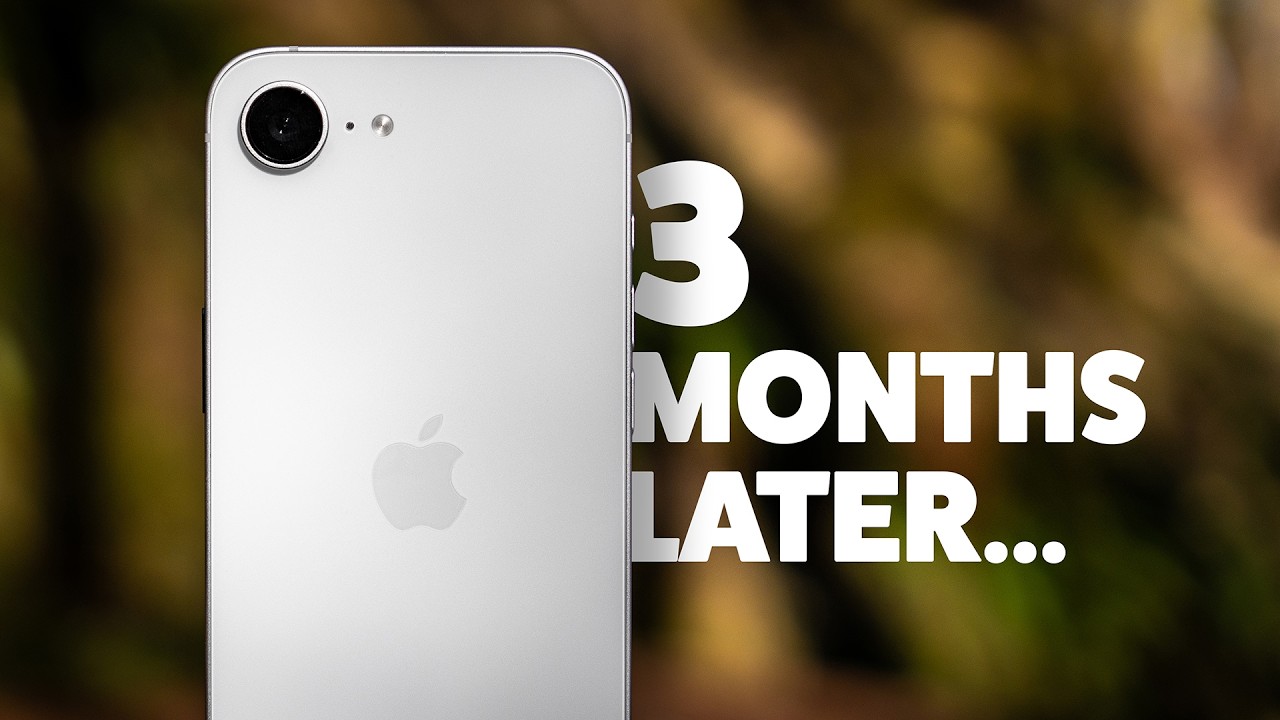
The standout feature of the iPhone 16E is its exceptional battery life, but we'll dive into why that's important later. I've had this phone for 3 months now, and I've been using it as my daily driver for about the last month and a half. By the end of this video, we'll answer two key questions: Is the 16e worth buying over the competition? And is it a worthy upgrade for those of you still holding on to an older iPhone SE?
For some context, my last iPhone was the 3G from 2008 that had 8 GB of storage and 128 MB of RAM. The 16e boasts 128 GB of storage and 8 GB of RAM. A lot has changed in the last 17 years. I've been exclusively on Android since then, so there'll be plenty of comparisons between the two operating systems in this review.
Price and Context
The 16e is the spiritual successor to the iPhone SE series, so let's compare it to the 2022 SE third generation. I usually cover price at the end of my reviews, but I think it provides some important context for the rest of this video. The iPhone 16E is $600 or £600 in the UK, which is a significant jump from the SE third generation's $429 starting price. We'll come back to whether I think the phone is good value at the end of the review.
Design and Build Quality
Design-wise, the 16e takes on a completely different design to the SE, being slightly larger and much boxier. The phone has fairly sharp edges, but isn't uncomfortable to hold, mainly due to it only weighing in at 167g. The back is refreshingly clean, largely due to its single upgraded 48-megapixel rear camera. However, unlike the SE's three colors, which included the punchy Product Red, the 16e only offers white and black.
The white version I have does well to hide fingerprints on its matte glass back. So, I'd recommend it if you plan on using this phone without a case. The brushed aluminum frame gives a high-quality feel, and I really like the clean aesthetic, which is refreshing in a world of giant camera bumps and camera islands.
Display and Face ID
Moving around to the front of the phone, the SE's large bezels and 4.7-inch IPS screen are gone, replaced by a cleaner, larger, and higher resolution 6.1-inch OLED. This brings back the mega notch of the older base iPhones rather than the functional Dynamic Island of the newer models. This also means Apple has got rid of Touch ID on this phone, replacing it with Face ID.
This has been consistently good with me only experiencing the odd time where it doesn't recognize my face. Plus, the infrared sensors allow it to work reliably in any lighting. I do miss a fingerprint sensor when the phone is flat on a table. But Face ID has a surprisingly wide field of view, so you just need to kind of tilt your head over the phone to get it to unlock.
Screen Refresh Rate Issues
By today's standards, the 16e has a fairly small screen, which keeps it compact, which is a big positive for me. Plus, the screen resolution is slightly higher than 1080p, meaning it's nice and sharp, and video and social media content look great on it. However, the screen is stuck at a 60 Hz refresh rate, so only refreshes 60 times per second. This is a huge downside for me as 120 Hz screens are now commonplace on far cheaper phones.
For those upgrading from the SE or who are new to 120 Hz, this won't be an issue. But after years of using high refresh rate screens on phones, for me, animations on the 16e feel noticeably less smooth, verging on laggy, which just isn't a great experience. The screen is bright enough for most situations, but can struggle in direct sunlight compared to competitors such as Google's Pixel series, which have consistently had ultra-bright displays.
Connectivity, Audio, and Charging
Moving to the bottom of the phone, Apple has replaced the Lightning port with USB-C, which is a welcome addition for me. However, if you're coming from an SE, your Lightning accessories won't work without a USB-C to Lightning adapter, so keep that in mind. This is also only a USB 2.0 port, offering very slow transfer speeds. I'd normally count this as a negative as I often transfer videos and photos via USB-C on my Android phones. But because AirDrop is so good, I can transfer these files much easier without a cable, which is a definite advantage of using an iPhone with my Mac.
Next to the USB-C port are the speakers, and these are some of the best I've heard in this price range, even compared to more expensive phones like the Samsung S25 and Google Pixel 9. As with most phones these days, the bottom speaker combines with the earpiece for stereo audio, and it gets nice and loud without distorting and offers a surprisingly full sound with lots of clarity. I listen to lots of music, audiobooks, and podcasts around the house while doing tasks. So, this is a big positive for me. Considering this is now Apple's cheapest new iPhone, they haven't cut corners on the speakers.
MagSafe and Charging Speed
An area where they have cut corners, though, is the lack of MagSafe, which disappointed some people when the phone was announced. If you previously used an iPhone with MagSafe and didn't use a case, this will be a problem. However, I think most people seriously considering this phone are one, coming from an older iPhone without MagSafe anyway, or two, will use a case. If you're one of those people, just get a case that supports magnetic charging.
I've been using this Spigen Liquid Air case with my 16E, and it's been great. It's grippy, provides good screen protection, and has built-in magnets for magnetic charging. However, the 16e only charges at 7.5 watts wirelessly, so it's pretty slow. There's no official wired charging speed from Apple, but it's likely around 20 to 25 W, which is fairly slow, but honestly hasn't been an issue for me.
Battery Life
As I mentioned at the start, battery life is where this phone really excels. The 16e packs a 4,050 mAh battery, which is small by Android standards, but pretty big by iPhone standards, resulting in some of the best battery life I've ever seen on a phone. Bear in mind, I usually use smaller phones, so around 6.4-inch screens or smaller. So, you might get better battery life on a larger phone with more battery capacity. But considering its size, this phone is a battery beast.
For light to medium tasks, it's a legitimate 2-day phone, achieving over 8 hours of screen-on time. For reference, based on my usage, I'd consider 6 hours a very good screen-on time. Over 8 hours is class. I've actually capped the battery at 80% to hopefully allow for better long-term battery health, and battery life still hasn't been an issue even with this cap.
One thing to note is that I use the OnePlus Watch 2, which isn't compatible with iPhone, so battery would likely be slightly worse with a constantly connected smartwatch, but I doubt it would make a significant difference. It's just so nice not having to worry about battery, especially on a long day out or if you're traveling long distance. This is a major positive for me, as battery life is probably one of the most important aspects for most people considering this phone, as it makes it reliable.
Performance and Hardware
Considering the price, general performance has also been very good. Powered by Apple's A18 chip, the A18 in the 16e has one less GPU core than the regular iPhone 16 with four instead of five cores. However, the phone handled all the gaming I've thrown at it with no issues. I guess it helps it only has to push 60 frames per second rather than 120 due to the screen limitation. The 16e got slightly warm when playing Wreckfest and Real Racing, but I mean barely noticeably warm. These games don't really push its GPU, showing the power it has.
Connectivity and Modem
Apple has also introduced a new in-house C1 modem. If you don't know, a modem is the component connecting your phone to the mobile network for calls, texts, and internet. I was particularly interested in testing this as I've mainly used Google's Pixel phones lately, where the modems have been very hit or miss, often causing major connectivity and battery issues. Fortunately, the C1 modem seems very good, staying consistently connected to 4G or 5G, and battery life on mobile data isn't notably worse than on Wi-Fi, which is great. This is positive for when Apple inevitably introduces these into the iPhone 17 series as it seems like a solid modem.
One other thing to note is that this phone lacks Ultra Wideband support. So, there's no support for precise AirTag pinpointing. That could be a dealbreaker for someone deep in the Apple ecosystem who frequently relies on that feature.
Software Experience: iOS vs Android
Although general performance is good, the software experience is where I've had some major gripes. Overall, it's been fairly positive. But there are things I just really prefer about Android.
Navigation and Focus Modes
Firstly, navigation on iOS is very inconsistent and annoying in my experience. On Android, if I'm anywhere in the OS, I can swipe left or right to go back. It's consistent. With iOS, going back can be an on-screen button, sometimes a left swipe. And I've had times where I've clicked a notification and there was no way back into the main app without closing and restarting it, which is just stupid. Android is just better at this. Full stop.
Next, I like that iOS has Focus modes, and I use them daily. But Android's implementation is far better. On iOS, with Work Focus enabled, you still see a summary of hidden notifications, which can be distracting. On Android, notifications are invisible until Work Focus is turned off, which I prefer, as I'm blocking apps for a reason: to avoid the distraction of notifications.
Additionally, in iOS Work Focus, apps are still fully accessible. In contrast, Android grays out blocked apps and asks if you want to use one for 5 minutes when you tap on it. If you do, after 4 minutes, the app goes grayscale and an on-screen reminder pops up to tell you that it will close due to Focus mode being activated. This is great for encouraging micro-breaks instead of getting fully distracted.
Typing and Apple Intelligence
Finally, the iOS typing experience has been much worse and less accurate than Android. For me, I find I really have to focus when typing on this phone compared to on Android, regardless of whether I'm using the iOS keyboard or Gboard. My typing has improved slightly over time, but I still consistently make more mistakes on iPhone. That said, dictation features are pretty solid and work well. Some of these issues are almost certainly user error, but I honestly expected a smoother software experience on iOS.
Apple's AI, dubbed Apple Intelligence, has basically been useless for me. The only places I've noticed it improving things are in dictation and in transcription and voice memos. Otherwise, I haven't used writing tools once, and intelligent Siri doesn't exist yet, at least at the time of making this video. I've actually set the Action Button to launch Gemini and activate the microphone, effectively using that as my voice assistant over Siri.
It seems that the main benefit of Apple Intelligence is that Apple gave us 8 GB of RAM, the same as the Pro phones. This isn't much by Android standards, which often have 16 GB, but it's a lot for an iPhone, as iOS is well optimized in terms of RAM usage compared to Android. Fundamentally, this should ensure the phone runs well for longer and is future-proofed.
Camera Capabilities
Aside from the software, the camera has been a mixed bag. At 48 megapixels, it's a much higher resolution than the SE third generation's 12 megapixels, but uses a fairly small 1/2.55-inch sensor. This means you can't really get any meaningful separation between the subject and the background like you can on phones with larger sensors. In good lighting, the camera works well, producing good colors and a sharp image. However, in low light, it can struggle with details becoming a bit fuzzy as the software works hard to reduce noise in the image.
Plus, compared to many other phones on the market, it's missing a second ultrawide camera. The 2x optical zoom option works pretty well, but it's a prime example of a marketing gimmick, as there's a fairly clear drop in detail between 1x and 2x images. Video quality is good in decent lighting, but folds apart a bit in darker conditions. The 16e doesn't get the more advanced sensor-shift stabilization that's available in the rest of the 16 series. This is noticeable when trying to get stable handheld footage. It does an okay job of stabilizing it digitally. But if the camera moves a lot, then you'll start to notice a lot of jitters and artifacts in the footage.
Only having one rear camera is honestly just quite limiting. And I often found myself wishing I had an ultrawide so I could capture an entire scene or just for a more interesting perspective. The front-facing camera that we're filming on now is the same 12-megapixel sensor that you get all the way up to the iPhone 16 Pro, and it gives me good quality shots and gets decently wide for the odd group selfie.
From an AI photo editing standpoint, Apple's cleanup tool uses generative AI to remove objects from photos, but it's objectively worse than the competition from Google and Samsung, which do a much better job at filling in the area where the removed object was. I also recently ran a YouTube poll asking how many of you use AI editing tools on your phone, and over 60% of you said you'd use them either only a few times or not at all. So, I'm not sure how much we actually need these features anyway.
Overall, if you just need your camera for photos of family, friends, and pets, mainly capturing key life moments, the 16e will do the job well. But if you're even slightly enthusiastic about your phone camera's results, there are better options out there that offer more versatility and better results for the same or less money. For example, Google's Pixel 9a is $100 cheaper than the 16e, offers a 48-megapixel main and 13-megapixel ultrawide, and I actually prefer the colors and contrast straight from that camera when compared to the 16e.
Value Proposition and Competition
This is a good point to discuss the 16e value proposition and whether you should buy it. Now, remember, Apple is asking $600 for this phone. For anyone coming from an Android phone, even a few years old, this phone will fundamentally feel like it's missing some essential features. If you've been used to 120 Hz screens, don't buy this phone. If you need more than one camera or really care about the quality of photos or videos, don't buy this phone.
A good example of better value in both these areas is Nothing's CMF2 Pro, which is almost 1/3 the price of the 16e at £219 in the UK, but it still offers a 120 Hz screen and three rear cameras: a 50-megapixel wide, a 50-megapixel telephoto, and an 8-megapixel ultrawide. Other things about that phone are inferior to the iPhone 16e, but the 120 Hz screen for that price versus 60 Hz in the iPhone is the main issue for me, highlighting how out of touch Apple is by offering a 60 Hz display in 2025.
Final Verdict
However, despite my fairly negative sentiment on its value, some people would enjoy using the 16e. Firstly, if you're coming from an older iPhone SE and waiting to upgrade and aren't willing to consider the Android alternatives, then basically everything about the iPhone 16 will be a massive upgrade. It has a much better rear camera, larger and nicer OLED display, better design in my opinion, a seriously powerful chip, and the main kicker: insane battery life. Crucially, this phone should keep running smoothly with good battery for 5 to 7 years, if not longer, which is particularly important for someone who keeps tech until it no longer works.
Alternatively, if you really value good battery life, need a smaller phone, and aren't bothered by the previously mentioned missing features, this could be a good choice. However, most of you watching are probably keen to get the best value when buying a new phone, and the iPhone 16e just doesn't really give you that. The most obvious alternative in my eyes is the aforementioned Pixel 9a, which goes for $499, which gives you an extra 13-megapixel ultrawide camera and a nice 120 Hz screen.
But if you're set on iPhone and aren't bothered by the 60 Hz screen or Apple Intelligence, but you need the extra camera, I would consider last year's iPhone 15, which you can now buy for just slightly more than the 16E refurbished directly from Apple. Fundamentally though, it's up to you whether you pick this phone up, as you'll know best if it meets your needs. But what do you think of the iPhone 16E? Let me know down in the comments. I've put an affiliate link in the description of this video if you want to pick this phone up for yourself. But I'm not going to lie, now this video is out, I'm switching straight back to Android.