Pixel 9 vs 8 vs 8a: The Ultimate Pixel Showdown!
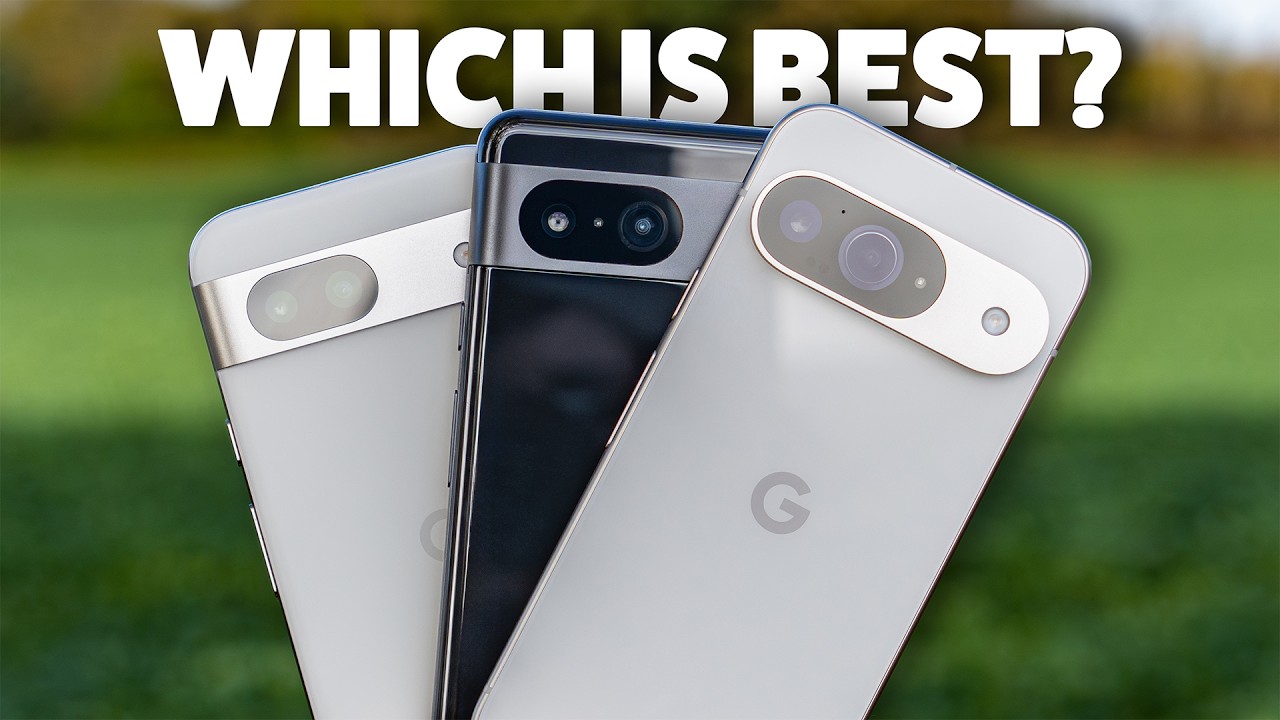
In this video, we're going to pit Google's Pixel 8a against the Pixel 8 and Pixel 9 and see which phone comes out on top. I used the Pixel 8 for over 6 months before switching to the Pixel 8a for 3 months, and now I've been using the Pixel 9 for over 2 months, so I've had a good amount of experience with all of these phones. We're going to use a point system in this comparison, so the winning phone in each category gets two points, the second phone gets one point, and the losing phone gets no points. Stick around until the end of the video to see which phone winds up with the most points. We're going to dive deep on this one, so buckle up and let's crack on.
Design and Build Quality
We're going to start with design and build quality, and from a visual perspective, I personally prefer the Pixel 9, followed by the Pixel 8a, and then the Pixel 8. All the phones have matte aluminum sides and camera sections, which I love because they avoid a load of fingerprints. The 9 and 8 both have glossy glass backs, whereas the 8a has a matte plastic composite back, making it the best for avoiding fingerprints if you're not using a case with the phone. The Pixel 8 in the dark Obsidian color is shocking for attracting fingerprints, so my advice would be to go for the lighter color of Pixel if you're getting either the 9 or 8, as the Porcelain Pixel 9 hides fingerprints far better than the Pixel 8.
Around the front of the phones, the Pixel 8a has some brutally large bezels, whereas the Pixel 8 has much smaller bezels but with an ever-so-slightly larger bottom bezel. If large or uneven bezels is something that bothers you, though, the Pixel 9 has a very satisfying uniform bezel around the screen, which just makes it look more premium. The Pixel 9 also feels more premium in the hand than the other two phones, with it feeling solid and with a good weight and balance to it. The Pixel 8 is also clearly built from premium materials, whereas the Pixel 8a is noticeably lighter and less premium feeling from my experience.
From a color perspective, I think the 8a has the brightest, most interesting colors, followed closely by the Pixel 9, and I think the 8's colors are pretty muted and on the whole a bit boring. However, this isn't really going to impact my score that much as I always slap a case on my phone to protect it, so I'm personally more interested in the practical aspects of the design. Based on all these observations for design and build quality, I'm going to give the win to the Pixel 9, followed by the 8, leaving the 8a in last place here simply because I think the bezels will immediately put a lot of people off, even though in real use they've never been an issue for me.
Durability
Build quality plays into the next category too, which is durability. With the back being made of plastic, you'd think the Pixel 8a would win this one outright, but we've also got to consider the screen glass and each phone's IP dust and water resistance ratings. The Pixel 8a has Corning Gorilla Glass 3, whereas the 8 has Gorilla Glass Victus, and the 9 has Victus 2. So what does this mean? Well, Gorilla Glass 3 was introduced in 2013, with Victus being released in 2020 and Victus 2 released in 2022. So there is 9 years of glass technology advances between the 3 and Victus 2 variants, and Corning suggests that Victus 2 should be able to withstand a 2-meter drop onto concrete without shattering, which is better protection than the glass on the 8a.
In real use, I do have a tiny but still visible scratch on my 8a screen and similar on the Pixel 8 screen, whereas the Pixel 9 doesn't have any scratches on it. This is despite me putting it face down on rocks to take thumbnails for videos and also dropping it so hard on its glass side at one point that it's got some scratches on the aluminum sides but still not on the glass, which is genuinely impressive. This doesn't mean I won't get a scratch on the screen, but it seems to be stronger from my experience with it so far.
Both the Pixel 9 and Pixel 8 have an IP68 rating for dust and waterproofing, which means they could be under up to 1.5 meters of water for up to 30 minutes. The Pixel 8a, on the other hand, has an IP67 rating, which means it can be under up to 1 meter of water for up to 30 minutes. For most people, this difference won't impact you at all, as if you accidentally drop any of these phones in the water before fishing it out within a few seconds, they should all be fine. But if you are someone who works near water frequently, then you may want the extra peace of mind that the higher IP rating of the 8 or 9 will bring you. In this case, I think the phones draw with one point each for durability, as the back of the 8a is much less likely to scratch or break than the 9 or 8, but the extra IP rating and harder glass of the 9 and 8 will likely make a difference in the long run as well.
Display
Next, there is not a huge amount of difference between the displays on these phones, with all three phones having 1080p resolution screens with a variable refresh rate between 60 and 120Hz. The differences between the displays are in the size and the brightness. The Pixel 9 gives us a 6.3-inch screen with a peak brightness of 2,700 nits and a 2 million to 1 contrast ratio, whereas the Pixel 8 and 8a both have a peak brightness of 2,000 nits and a contrast ratio of 1 million to 1, with screen sizes of 6.2 and 6.1 inches respectively.
In real-world use, there isn't a huge difference between the screens, with all of them getting bright enough to use on a bright sunny day and all of them being nice and smooth with that 120Hz refresh rate. However, if you need that extra brightness or the slightly larger screen, then the Pixel 9 is going to be the phone you should go for, which is why it edges out the victory in this category, with the Pixel 8 and 8a drawing in second place because there is so little difference between their displays.
Biometrics
Under the screens of all of these phones is a fingerprint sensor which, alongside Face Unlock, makes up the two biometric security options built into these phones. Face Unlock is equally snappy on all these phones, which is good when you have enough light, but when it's dark it doesn't work at all. The fingerprint sensor is where there is a huge difference between these phones. The Pixel 8 and 8a have a fairly slow and sometimes inaccurate optical fingerprint sensor, whereas the Pixel 9 has a very fast and accurate ultrasonic fingerprint sensor. This makes the Pixel 9 much easier to unlock regardless of the level of light in the room. However, bear in mind that all these phones still tend to struggle with the fingerprint sensor if your hands are wet. For this category, it's an easy win for the Pixel 9, with the Pixel 8 and 8a once again drawing for a single point.
Audio Quality
Moving down to the bottom of the phone, let's talk about the speakers on these phones. I use my phone all the time for listening to podcasts, watching videos, or listening to music when I'm doing tasks around the house, so I've had extensive experience using all three of these phones for this. The Pixel 9 for me has a good level of balanced, clear audio while also being able to get pretty loud. The Pixel 8 also provides good audio quality but lacks some of the volume of the Pixel 9. Finally, the Pixel 8a is not great, especially at max volume where it introduces some nasty frequencies and just doesn't sound very good at all.
With regards to call quality, calls sound crisp and clear on all of these phones through the speaker at the top of the phone. One other thing to mention here is that the Pixel 8 and 9 both offer Spatial Audio with supported headphones, which is basically virtual surround sound, whereas this is not included in the 8a. I've honestly never used Spatial Audio, so it's not really important for me, but definitely worth mentioning in case it matters to you. In this category, the Pixel 9 wins, the Pixel 8 comes second, and the Pixel 8a misses out on points.
Connectivity
A closer call between these phones is connectivity. They all have a USB 3.2 Type-C connector which offers transfer speeds of up to 10Gbps, and they all have the same Bluetooth 5.3. The only place they differ is in Wi-Fi support, where the Pixel 8a supports Wi-Fi 6E, but the 8 and 9 both support the faster Wi-Fi 7. Due to this, I'm going to have to give the joint win to the Pixel 8 and 9, with the Pixel 8a coming in with one point. Before we move on to the cameras, if you are enjoying this video so far, then please drop a like. I appreciate you.
Cameras
The camera performance on these phones might be the make or break for a lot of people about which phone you decide to buy. Fortunately, in my experience, the cameras across all the phones are very good. The Pixel 8 and 9 both sport the same 50-megapixel main camera, but the 9 has an upgraded 48-megapixel ultra-wide over the 12-megapixel ultra-wide of the 8. The 9 actually shares two of the three camera sensors that are on the more expensive 9 Pro and 9 Pro XL, which is great. The higher megapixel count in the ultra-wide sensor does make a difference, with the images from the Pixel 9 being slightly sharper and more detailed than the 8.
Both phones have the same 10.5-megapixel front-facing camera; however, the camera on the Pixel 9 includes autofocus, whereas the 8 only has fixed focus. In my experience, this doesn't make that much of a difference as the photos out of the front-facing camera aren't super detailed anyway. The Pixel 8a has a 13-megapixel front-facing camera, which is obviously higher resolution than the 8 and 9, but the results from all three phones are honestly very similar in this regard.
The Pixel 8a actually has a higher megapixel main camera at 64 megapixels; however, this is the same sensor that was used in the 7a, so it's fairly old now by smartphone standards. The 8a also has the same ultra-wide sensor from the 7a, which provides 13-megapixel images. In well-lit scenarios, all the cameras on each of these phones perform really well; even the 8a with its older sensors produces excellent, contrasty, and well-balanced images. However, when you stick them in low-light situations, the larger main sensors on the 8 and 9 really stand out by maintaining their image quality even without using Google's Night Sight mode.
Although it has the same main sensor as the 8, the 9 has a new image processing pipeline, and this seems to make a difference in how clean and detailed the low-light shots look. The 9 also takes this one step further with its upgraded ultra-wide, which seems to be significantly better in low light when compared to the 8 and far better than the 8a's ultra-wide, which is significantly worse in low light even when using Night Sight. The 8 and 9 also offer Macro Mode, where this is missing on the 8a, so if you're someone who values getting close-up shots, then the 8a is going to be a no-go for you.
There are also other camera software features which are exclusive to the Pixel 9 and 8. These phones both have the Action Pan mode, which allows you to shoot a moving subject and create a motion blur behind that subject, and Night Sight Time Lapse, both features which are absent from the Pixel 8a. On the Pixel 9, you get the Add Me feature, which allows you to add someone into an existing photo by taking a second photo with them in it and intelligently stitching them together, and get the new Panorama mode, which should make it easier to take panoramas with better results.
I need to mention that this Pixel 8 has an issue where it doesn't focus when you initially open the camera until you shake the phone; however, I'm not going to count this as a negative for the 8 as I've determined that this is a hardware issue, and from the comments on my previous videos, no one else has had the same issue. I think it must have been caused by me dropping the phone at some point, as I don't remember it being an issue when I first got the phone.
In terms of video, all the cameras can shoot up to 4K at 60 frames per second, but for some reason, only the Pixel 8 and 9 can shoot 24 frames per second, with the 8a being limited to 30 and 60 frames per second. The stabilization is fairly similar on all the cameras, which is to say it's good in all but the most difficult of situations, such as filming handheld while walking over uneven ground where you may see some stabilization jitters. Another feature that is omitted from the 8a is the ability to shoot 10-bit HDR video, which doesn't really bother me, but it can give you super bright highlights and more realistic darker blacks if you care about that. And finally, the 8 and 9 can shoot with the Cinematic Blur video mode, which is also missing on the 8a. This puts an artificial blur behind the subject that you're shooting, but it looks pretty fake in my opinion because the quality of the subject cutout isn't very good, plus the quality is limited to 1080p in this mode rather than 4K.
The lack of the various software features doesn't really bother me that much between the different phones. I think the quality of the Pixel 9's images is just overall consistently slightly higher than the 8 and 8a, and the Macro Mode could be important for certain users. Based on this, the 9 gets the win in the camera category for me, and the Pixel 8 comes second with the 8a coming in last.
Battery Life and Charging
Next is a really important category for me, and that's battery life. The Pixel 8 and 8a had an underwhelming battery life in my use, with the Pixel 8 being slightly better than the 8a but still being fairly average, with me ending the day with about 10 to 20% battery left after about 3 to 4 hours of screen-on time and mixed use. This is mainly due to the pretty rubbish modem in the 8 and 8a, meaning that my battery performance on mobile data was substantially worse than when I was connected to Wi-Fi.
In contrast, in the first two months of use, I've been very pleased with the Pixel 9's battery performance. While it's not exceptional, it sits firmly in the good category rather than average, which is a huge improvement over the Pixel 8 and 8a. I can comfortably use the phone for mixed normal use and even hit 4 to 5 hours of screen-on time and not be worried about making it to the end of the day. I very rarely got to the end of the day with the 9 and had less than 15% battery left, which is class. So the Pixel 9 wins this category, with the 8 getting the single point and the 8a getting zero.
Charging goes hand-in-hand with battery life, as often you may need to top up your phone after a long day at work to get ready for a night out. The Pixel 8 and 9 offer similar charging speeds, with both hitting 27 watts of wired charging and both hitting 12 watts of wireless charging with a Qi-certified charger. However, if you have Google's Pixel Stand, the Pixel 8 can hit 18 watts for wireless charging, whereas the Pixel 9 can only hit 15 watts, which is weird considering the Pixel 9 is the newer phone and the fact it has a larger battery. The Pixel 8a falls far behind in this category and is one of the worst parts of this phone in my opinion, as it only charges at 18 watts wired and a measly 7.5 watts wirelessly.
Another thing to note here is that the 8 and 9 both support Battery Share, which allows you to wirelessly charge another phone or device with your Pixel, but the 8a doesn't support this. In my experience, charging speed hasn't been a huge issue as I tend to put my phone on charge before I go to bed and wake up with it fully charged. Plus, all the Pixels here support Google's Adaptive Charging, which only fast charges your phone up to 80% when you put it on charge when you go to bed and then trickle charges it to 100% in time for you waking up, which should boost the longevity of the battery. However, if you don't charge your phone overnight like me, then charging will be very important. So the Pixel 8 actually takes the win here, followed by the Pixel 9, and the 8a falls into last place again.
Performance
In terms of performance, both the 8 and 8a have the same Tensor G3 chip, both with 8GB of RAM, whereas the Pixel 9 offers the newer Tensor G4 chip with 12GB of RAM. The performance on all these phones is very similar across the board, to be honest. In everyday use of swiping around Android 15, scrolling social media, messaging, and watching or listening to content, there honestly really isn't any notable difference between how these phones run. They all run really smoothly in my experience.
The only times the phones get warm in my use of them is when I'm gaming for an extended period or downloading large files from the internet. I can play Call of Duty: Warzone Mobile with the graphics and frame rate settings set to the highest that the game allows for over an hour, and all the phones get hot, but I don't get any noticeable lag or slowdown, which is good. However, I'm in Scotland and it never really gets past about 25°C here, so if you're in a hotter environment, then I think it would be possible for these phones to overheat as they do get hot to the touch when you're doing some heavy gaming. At least in Call of Duty, you could reduce some of the graphics settings and you'd probably be fine. However, it's safe to say that if you're looking for a powerful phone for doing heavy gaming sessions or for photo and video editing regularly, then I think there are definitely better phones out there for those use cases. For the average user who does some gaming every now and then and mainly uses the phone for everyday things, then I think you'd be happy with the performance of any of these phones. So in terms of performance, because of the slightly faster chip and the 50% extra RAM over the 8 and 8a, I'm going to give the Pixel 9 the win here, with the 8 and 8a getting a point each because they are evenly matched.
Future Proofing and Longevity
We also have to consider future-proofing and longevity though, and all these phones have good prospects in that regard. From a software perspective at least, Google has promised 7 years of OS and security updates for each of these phones. It's also clear that Google is going to be developing many different AI software features going forward. I've already noticed features that were released as features exclusive to the Pixel 9 trickling down to the 8 and 8a only a few months after the 9 was released, such as Gemini Live and the Pixel Weather app. However, the fact that the Pixel 9 has a slightly more powerful chip and 12GB of RAM is going to ensure that it can keep up with any new features for longer than the older 8 series of phones. Because of this, I'm going to give the win here to the Pixel 9 and give the 8 and 8a both a point each.
Software Features
For our penultimate category, we have the software features, and there aren't many differences between these phones beyond the camera features that we've already discussed. There aren't any software differences between the Pixel 8 and 8a beyond the features in the camera and things like Spatial Audio support and Battery Share that I've already mentioned. However, the Pixel 9 has some exclusive software features. Firstly, in the Photos app, the Pixel 9 allows you to Reimagine photos, which basically uses generative AI to add new elements to any photo. You just need to draw over a section of the photo and describe what you want to be added, and it'll give you a few different options to choose from. I've honestly used this infrequently on my Pixel 9, and I've only really used it to create fun edits of my rabbits.
The Pixel 9 also has Auto Frame in the Photos app, which allows you to use generative AI to expand an image. This will generate new pixels around the outside of the image and give you a few different aspect ratios to choose from. I've not used this apart from when I've been testing it, so I wouldn't miss it if I didn't have it. Next, the 9 has Pixel Screenshots, which allows you to use normal language to search for specific screenshots to make them easier to find. So if you're the type of person who takes a screenshot of important information to remember it, then this is going to make those screenshots a lot easier to find after the fact.
Pixel 9 users also get Pixel Studio, which allows you to generate images with AI on your device using a text prompt, which is quite cool but doesn't really provide much value in day-to-day use. We also get an AI-generated weather summary in the Pixel Weather app, which uses AI to summarize the weather forecast for you. This definitely isn't something you'll miss on the Pixel 8 or 8a as you can just, you know, look at the weather forecast. For Reimagine, Auto Frame, and the AI weather summary, I can see these being brought to the Pixel 8 and 8a and possibly older Pixels in the not-too-distant future, as these are features that could be processed on Google servers.
Pixel Studio can basically be replicated on any device that has access to Gemini, as you can now generate images using Google's Imagen 3 image generation model, so I don't see this as a reason to get the Pixel 9. As far as I'm aware, the Pixel Screenshots app uses the on-device Gemini Nano model more heavily than the other features here, so may require the extra RAM of the Pixel 9. However, I wouldn't be surprised in the slightest if Google gets rid of the Screenshots app in the future and integrates this as a feature in Google Photos; it'll be accessible by all devices. The Pixel 9 still wins this category because it does have these extra features. I'm giving the 8 and 8a a point each because I don't think the missing features are going to be deal-breakers for the vast majority of people, and there's a good chance that we will see these on the older phones in some form in the future.
Price and Value
And this brings us on to our final and possibly most important category: price and value. The price can be the decider at the end of the day because it's really based on what you can afford and what gives you the most features for your money. Because of this, I'm going to give the first place in this category 10 points, second place 5 points, and the last place 0 points. The Pixel 9 is naturally the most expensive phone here, being the newest and most feature-packed, and comes in at $799 or £799 but can already be had for $100 off when the sales come around. The Pixel 8a is the cheapest, coming in at $499 or £499, but has already been down to under $400 on sale. Finally, the Pixel 8 is now being sold at an RRP of $599 or £599 but can regularly be picked up for under $500 when it's on sale.
The key thing between all of these phones is that I would never recommend you buy them at full price. Wait a month or so for a sale and you'll be able to save a lot of money on them. In my opinion, the Pixel 8 is the best value for money, especially if you can pick it up for $500 or less, so I'm giving it the 10 points here, followed by the Pixel 8a for 5 points, and inevitably the Pixel 9 comes in last in this category as it's just a lot more expensive than the 8 and the 8a.
Conclusion
So as you can see, the Pixel 8 came in with a sprint finish at the very last, which means it's pipped the Pixel 9 to the win in our Pixel battle. Based on these scores, which one of these phones should you buy? Well, if you have a budget of $400 or less, then go for the Pixel 8a when it's next on sale, and I'm sure you'll be happy with it if you're okay with the large bezels, the slow charging speed, and the average battery life. If you want the best value for money, then for me the Pixel 8 is the one to go for because if you can get it for less than $500, then it's a lot of phone for that price. Finally, if you just want the most refined phone with the most features and the best experience out of these three and the price isn't really a factor for you, then the Pixel 9 is definitely the one you should get as it fixes a lot of the aspects I wasn't so keen on with the Pixel 8 and 8a. If you've decided you want to pick up one of these phones, then I've dropped some links down in the description for you. But do you agree with the points that I awarded to each of these phones? Let me know down in the comments below. Otherwise, as always, it's been an absolute pleasure and I'll catch you all in the next video. Cheers.