iPhone 17 vs iPhone Air: Full Comparison & Honest Review
Apple recently launched their new iPhones. In this video, we'll compare the base iPhone 17 to the brand new iPhone Air to see which is right for you. We'll break this down into six categories, which are on screen now.
Design
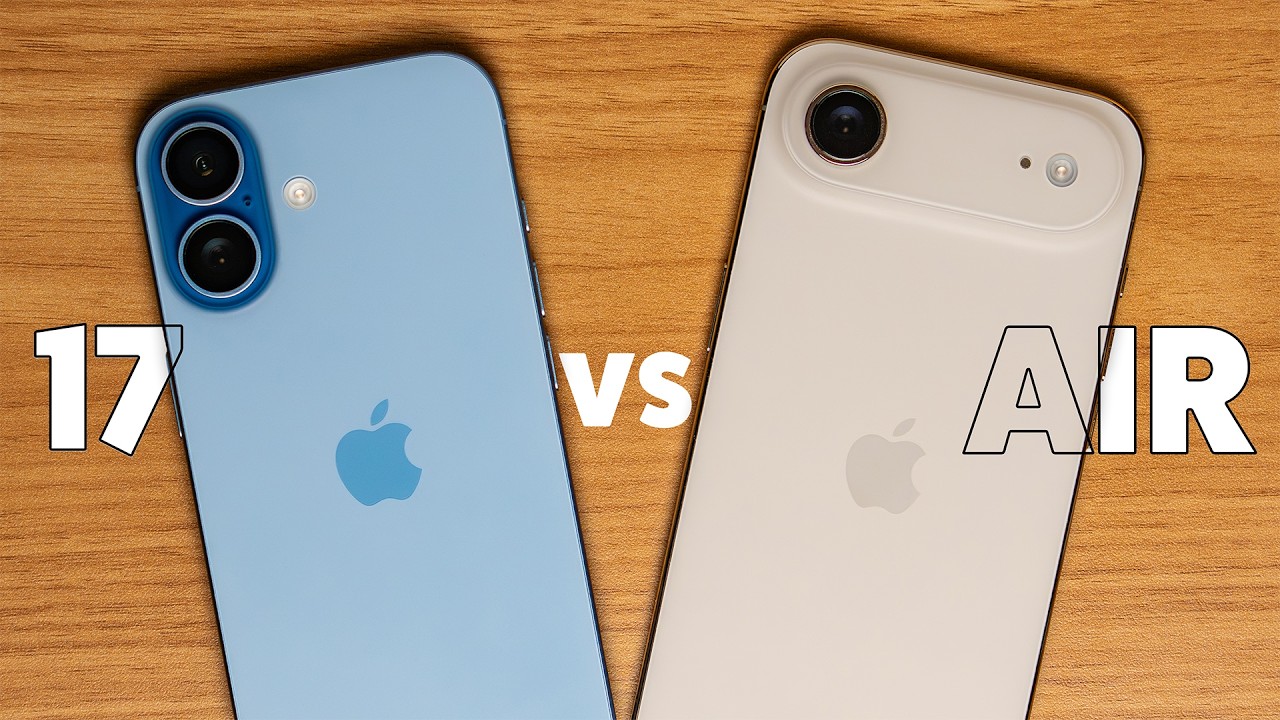
Let's start with design, where there are quite significant differences. The Air has a larger 6.5-inch screen over the 17's 6.3-inch display, but is 7% lighter than the 17 at 165 g versus 177 g. In reality, the Air does feel lighter in the hand, perhaps because there is less weight distributed over a larger surface. The Air is also ridiculously thin at just 5.64 mm, which is 29% thinner than the 17's 7.95 mm. I've handed the Air to quite a few people since I started using it, and they've all immediately commented on the form factor. However, the Air's measurement doesn't include its camera plateau, which houses most of its components, which measures in at roughly 11.44 mm.
The side rails on the Air are made of glossy color-matched titanium, which unsurprisingly attracts a lot of fingerprints, whereas the iPhone 17 has brushed color-matched aluminium, which hides fingerprints a lot more effectively. The back of the Air is made of Apple's ceramic shield, where the iPhone 17 just uses basic glass. Round the front, both phones get Apple's new and improved Ceramic Shield 2, which Apple claims is two times more durable. If you somehow haven't seen JerryRigEverything's durability test of the Air, he shows that its build quality is ridiculously good. It sustains some insane bending force and the Ceramic Shield 2 on the front scratches way less easily than most other phones out there. His durability test of the iPhone 17 shows that it's also a beast when it comes to durability. So, I don't think you can go wrong with either phone in this aspect.
I chose the light gold version of the iPhone Air, which is a very subtle color, basically gold-tinged white. The Air's three other colors, space black, cloud white, and sky blue, are pretty muted and subtle, too. In contrast, this mist blue version of the iPhone 17 definitely has a more saturated color, but is still quite pale in comparison to my blue Google Pixel 10. The 17's five colors definitely offer more variety and saturation than the Air. So, if color is important to you, then the 17 is the way to go.
One thing to note is that the iPhone Air is eSIM globally, with Apple claiming that this was to allow them to add more battery. There are 12 countries, including the US, that are eSIM only across the entire iPhone 17 lineup. But everywhere else, including here in the UK, we still get a physical nano SIM slot on the iPhone 17 and the Pros. Switching to eSIM was pretty straightforward for me, but it can be more difficult or even impossible depending on which phone network you're on. For example, at the time of filming, Lebara in the UK doesn't even offer eSIM support. So, make sure to check your network provider before you decide to buy an Air.
Ultimately, for me, I think the iPhone Air comes out on top in terms of design. Mainly because it's something new from Apple, and it's impressive how they've basically put all the phone's components except the battery in the plateau at the top of the phone, which has allowed them to keep it so thin and light while clearly not sacrificing durability.
Protection and Accessories
However, after spending a load of money on the Air, the absolute best way to protect its sleek design is to put it in a case, which you can get from this video sponsor, Dbrand. They've sent me their new Tank case. This case has ridges and grooves that give you extra grip and excellent protection around the sides of the phone to protect it from drops. With 10 unique textures around the case, it's super tactile and feels excellent in the hand. Around the sides, you get satisfyingly clickable modular buttons which can be easily swapped out so you can find ones that match your style. The case is also MagSafe compatible with seriously strong magnets.
Round the front, it has a good-sized lip around the screen to protect it from drops. And to doubly protect the screen, you can slap on one of Dbrand's Prism 2.0 screen protectors, which takes just seconds to apply. Alongside the Tank case, Dbrand have a load of other cases and skins for the Air and the iPhone 17, too. Use the code Aaron Brown via the link in the description to get 42% off the Prism 2.0 screen protector if you bundle it with one of Dbrand's Tank, Ghost, or Grip cases. A huge thanks to Dbrand for sponsoring this video.
Displays
Moving on, let's talk about displays. The Air is slightly larger at 6.5 inches over the 17's 6.3 inches. Other than size, though, the displays are nearly identical. Both have the same Dynamic Island at the top, tiny, super clean bezels, and the same resolution at 460 pixels per inch, which makes for an excellent experience in real use. They are both OLED screens and come with a new anti-reflective coating, which definitely reduces glare slightly when compared to my other phones, such as the Pixel 10.
Brightness specs are also the same, and both can hit 1,000 nits of typical brightness and 3,000 nits of peak auto brightness outdoors, and this definitely makes them more than bright enough for any lighting situation. They also go all the way down to one nit at the minimum, which is great when you're looking at your phone at night. Both phones have ProMotion, which means they are capable of dynamically switching between 1 and 120 Hz, and this is so much smoother than the 60 Hz that I complained about in my iPhone 16 review. Plus, it's important to note that this is a first for the base iPhone this year, which is a very big deal as the 17 can now actually compete with Android phones in its price range in this respect.
Since the screens are so similar here, it really comes down to size preference. I personally prefer a smaller screen for reachability, but you may prefer a larger screen for the better content viewing experience, and the iPhone Air at least isn't a behemoth like most of the 6.9-inch phones we have out there these days. For this reason, I think they draw in this category.
Cameras
Next, let's talk cameras. The immediate difference between these two phones is that the 17 has two 48-megapixel wide and ultrawide cameras on the back, while the Air has one 48-megapixel wide camera. The main wide sensors are identical and produce the same sharp 24-megapixel images with the option for full 48 megapixels, including optical quality 2x zoom by cropping the sensor. I've stuck with the 24-megapixel image option. But I like that I have the option to shoot with the full resolution.
I'm not a massive fan of the iPhone's standard color profile, but you can use their Photographic Styles to edit how the photos look straight out the camera. And I found that I really like the results of the amber style that warms up the highlights. So, I've mainly been shooting using that. The iPhone 17's ultrawide gives you a lot more versatility than the Air, allowing for wider shots where you need that extra field of view and also for macro mode for super close-up subjects, a feature that's absent on the Air.
This is what the main camera out of the iPhone Air and obviously the iPhone 17 looks like mounted on a tripod for a talking headshot. And this is what the ultrawide camera on the 17 looks like mounted on a tripod for a talking headshot. Both phones are capable of shooting 4K at up to 60 frames per second. I'm now filming using the cinematic video mode on the iPhone 17 and for some reason this is missing on the iPhone Air despite me now filming this on the front-facing camera which is exactly the same on the iPhone Air. And the Air is also lacking the ability to create spatial photos and video due to only having one camera.
Apple has introduced a really cool new front-facing camera with a 24-megapixel square sensor that allows you to take either portrait or landscape photos regardless of the orientation of the phone, which is just a really cool innovation which is going to make taking selfies and fitting everyone in way easier. This is the same on both phones, so you won't miss out on this feature regardless of which phone you choose to get. The microphones seem very good on both phones when you're close enough to the phone and there doesn't seem to be a significant difference between the two phones in this aspect.
Apple has introduced dual capture video on both these phones, which means that you can show what your rear camera is seeing as well as what your front-facing camera is seeing. So, I can show you this massive downed tree, for example, that I found, and I can show you my reaction to it. This is a feature that has been in Android phones for quite a while now, but it's nice to see it coming to iPhone. And I think it's going to be used quite a lot in vertical content like TikTok for example. You can also move your face around if it's covering a part of the frame. You can move it to any of the four corners and you can see that movement in the actual video itself. It's baked in.
Overall, the iPhone 17 takes the win in the camera department because it has that extra ultrawide on the back of the phone and ultimately has more features and versatility.
Performance
Now on to performance. The iPhone 17 gets the new A19 chip with a six-core CPU made up of two performance cores and four efficiency cores and a 5-core GPU. The Air gets the beefier A19 Pro which has the same number of CPU cores and the same two and four core configuration and also gets a binned 5-core version of the GPU when compared to the six-core GPU in the Pro phones. However, the Air actually has 50% more RAM with 12 GB versus the 8 GB in the 17, which could make a difference in how these phones run future Apple Intelligence features if you care about that.
In benchmarks, looking at Geekbench, the Air has a very slender edge when it comes to raw CPU and GPU power. But for testing sustained performance, which is more realistic if you're gaming, I used 3DMark Wildlife Extreme Stress Test, which pushes the GPU and CPU in 1-minute long benchmark loops for 20 minutes to see how its performance changes over time. I took the average scores of three runs of each phone. Interestingly, the iPhone 17 produces a 14% better average best loop run and 10% better average worst loop run than the Air, meaning you get better sustained performance from the 17.
But for a more realistic real-world test, I tried gaming in Delta Force for an hour on each of these phones with the frame rate set to 120 frames per second and the graphics set to standard, which is the maximum the game allowed at this frame rate. Both phones got hot with the Air's heat concentrated just below the raised plateau and the 17's more evenly dispersed over the back of the phone. Without a case, this resulted in pretty uncomfortably warm hands over the hour with both phones. However, I didn't notice any lag or frame drops on either phone. And apart from the hot hands, the gaming experience was excellent on both.
From these tests, I suspect Apple have deliberately significantly underclocked the A19 Pro in the Air to minimize heat and increase its efficiency at the expense of raw power. And that suspicion is backed up by the fact the 17 consistently used a higher percentage of battery across the benchmark and real-world gaming tests.
Connectivity and Audio
In terms of connectivity, the phones have different modems with the 17 using a Qualcomm modem while the Air uses the new Apple C1X. The C1X lacks any sort of millimeter wave 5G support, which could be a dealbreaker if that's something you value in your phone. In the UK at least, millimeter wave hasn't been rolled out here, except in specific trials, so it's not an issue for me. I've not really seen any issues with either of the modems on these phones in the time I've used them so far, and they both seem to provide a reliable mobile data connection. Both phones also get the new Apple N1 chip, which enables Wi-Fi 7, Bluetooth 6, and Thread, and I've not noticed any issues with Wi-Fi or Bluetooth performance on either phone, which is good.
I also tested the experience of watching content on both these phones, as while the 17 has stereo speakers at the top and bottom of the phone, the Air only has a single speaker housed in the top of the phone. The Air's single speaker just overall sounds worse than the 17's because it really lacks bass and just can't get to the same volume. This is really noticeable when watching or listening to content.
Overall, from my tests, I think the iPhone 17 wins this category by not only having better sustained performance despite seeming to have very slightly worse efficiency, but by also providing a much better experience of watching and listening to content purely because of the much better speakers.
Battery Performance
The penultimate category is battery performance where the iPhone 17 has a 3,692 mAh battery which is 17% larger than the Air's 3,149 mAh battery. I consistently achieved between 5.5 and 6.5 hours of screen on time with the 17 over my four to 5 days of using it with 20 to 30% battery left at the end of a 15-hour day, and that was using it like I use all my phones, mainly for listening to Spotify, messaging people, and watching content on social media.
Using the Air and mainly the same way, while battery life was definitely worse, it wasn't terrible at all. With both these phones, it really depends on how you use your phone. On a day where I was using Google Maps and Spotify on mobile data on my Air for nearly 3 hours, the phone had 1% battery remaining after around 4.5 hours of screen on time. And this was at about 7:00 p.m. So, it can certainly die within a day if you push it hard enough. However, if you use light apps with a mix of Wi-Fi and mobile data on a full charge, I reckon you can easily get anywhere from 5 to 6 hours of screen on time with the Air and probably about 7 to 9 hours of screen on time from the 17, which is excellent performance when I compare it to the other phones I've used.
Aside from battery life, charging speed is another thing to consider. Apple claims that the 17 can get 50% charge in 20 minutes, while the Air takes 30 minutes to achieve the same charge. I tested this and the 17 took just over 24.5 minutes to add 50% charge, while the Air took 37 minutes and 41 seconds to do the same. I was using a 100 W charger for this, so it theoretically should have been charging at full speed, but I wasn't able to verify this. Wireless charging speeds are apparently the same on both phones with the phones capable of charging 50% in 30 minutes. I don't have a 25 watt MagSafe charger. So, unfortunately, I wasn't able to test this, but as they are the same, this doesn't really make a difference.
Overall, and unsurprisingly, the iPhone 17 wins this category with a larger, longer-lasting battery and faster wired charging speeds.
Price and Value
The final category is, of course, price and value. The iPhone 17 goes for $799, while the iPhone Air goes for $999. Both phones start at 256 GB of storage this year, which makes the iPhone 17 stand out as not just better value over the Air, but also even better value when comparing it to last year's iPhone 16, which started at the same price and at 128 GB.
The only real reason you should buy the Air is if you really value how your phone looks and want the newest looking, most premium feeling iPhone. Clearly, it does make compromises though, including the worst battery life and single camera. And you've got to consider that the battery life will get even worse over the life of the phone. For most people though, I'm very confident that the 17 is a better buy as it consistently matches or provides more features than the Air throughout all the categories, except perhaps from a design perspective. But even then, I know there will be a lot of people out there who prefer the 17's design.
I think if the 17 still had a 60 Hz screen like the iPhone 16 from last year, then this might be a more difficult conclusion. But from a practical point of view, the base iPhone 17 is great value this year with the ProMotion screen, the dual 48 MP rear cameras, the excellent new front-facing camera, better battery life and charging, and very good performance. It's definitely the one I would go for even if I had $1,000 to spend. I'd save $200 and get the 17 as the Air compromises on too many aspects for me, and I also just prefer smaller phones.
But which one would you buy? Let me know down in the comments. And I've left affiliate links in the description if you're keen to buy either of these phones. Otherwise, hit that subscribe button if you want to see my long-term review of both these phones in a few months time. Cheers.